Fruit Fly Season in the Kitchen? How to Stop Bugs Around Your Compost Caddy
If you are doing kitchen composting, you already know the upside. Less food waste in landfill, fewer smelly bin liners, and a nice steady stream of scraps for your compost bin, worm farm, bokashi, or council green waste.
Then fruit fly season hits and suddenly your good habit feels like a punishment.
Fruit flies in the kitchen are not a sign you are doing composting “wrong”. They are simply doing what they do best: finding moist, sweet food scraps (especially fruit) and multiplying quickly. The goal is not perfection. The goal is a setup that makes it hard for them to breed, and easy for us to stay consistent.
This guide walks through what actually works: compostable liners, a realistic compost caddy routine, compost caddy cleaning tips, and a few indoor compost tips that suit Aussie homes.
Why fruit flies love a compost caddy
A compost caddy is basically a tiny buffet that gets topped up all day. Fruit flies are attracted to:
- Overripe fruit scraps (banana peels, mango skins, melon rinds)
- Fermenting food scraps (anything that has started breaking down)
- Moisture and warmth (summer kitchens, cupboards, near the kettle)
- Residue (a thin smear inside the caddy is enough to feed larvae)
Fruit flies do not need much space. If they can land, feed, and lay eggs, they will.

The quickest win: change what goes into the caddy (and how)
Before we talk traps and sprays, it helps to tighten the “front end” of your system.
Keep the fruit scraps “dry on the surface”
Moisture is a breeding advantage. Try:
- Letting juicy fruit scraps drain for a few seconds before they go in
- Wrapping very wet scraps in a little paper towel or torn cardboard
- Adding a small “brown buffer” layer (shredded paper, cardboard, dry leaves) in the bottom of the caddy
This improves kitchen odour control as well, because you reduce that wet, fermenty layer that smells strongest.
Freeze the worst offenders
If fruit flies kitchen problems are intense, freezing is a game changer.
Keep a container in the freezer for:
- Banana peels
- Mango skins
- Melon scraps
- Soft berries
- Onion skins and garlic (also strong-smelling)
Then tip the frozen scraps into your compost caddy shortly before you take it out, or straight to your outdoor system. It breaks the breeding cycle because the scraps are not sitting at room temperature for days.
Do not “marinate” scraps on the bench
If you are collecting food scraps while cooking, tip them into the compost caddy as you go and close the lid. A small habit, big difference.

Compostable liners: why they help (and how to use them properly)
Compostable liners can be brilliant for indoor compost tips, but only if we use them with a bit of common sense.
Why compostable liners help:
- They reduce residue stuck to the caddy walls
- They make emptying faster, so we do it more often
- They reduce lingering smells that attract flies
How to use them so they do not get gross:
- Do not overfill. Overfilled liners split and leak.
- Keep the caddy out of direct sun.
- Empty more often in hot weather (every 1 to 2 days is normal in summer).
- Add a dry layer first (paper, cardboard) to reduce liquid pooling.
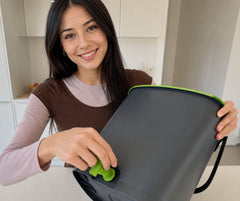
If you want to see options we stock, our kitchen compost range includes caddies bundled with liners, like “7L Kitchen Caddy with 20 x Compostable Bags” and “7L Kitchen Caddy with 40 x Compostable Bags”, plus slim options like “9L MAZE Slim Caddy With 20 Compostable Bags” and “9L MAZE Slim Caddy With 40 Compostable Bags”.
You can browse the full collection here: Kitchen Compost Bin.
We also stock paper bag options (for example, “7L Compost Caddy with 10 Paper Bags”), which some households prefer for absorbing moisture.
The compost caddy routine that actually stops fruit flies
If we had to pick one thing that works best, it is consistency. Fruit flies are fast, so our routine has to be simple enough to stick to.
Daily (takes 30 seconds)
- Keep the lid closed when you are not adding scraps.
- Wipe the rim quickly if anything splashes or smears.
- If you have a lot of fruit, empty every night during peak season.
Two to three times per week (or every time you empty)
- Rinse the caddy with hot water
- Dry it properly (even a quick air-dry helps)
Weekly (10 minutes, makes a massive difference)
Do a proper compost caddy cleaning reset:
- Wash with warm soapy water.
- Give it a quick sanitising rinse using one of these:
- Vinegar and water (good for smells and residue)
- Bicarb paste for any stuck-on grime
- Dry it fully before relining.
Drying matters. A damp caddy left closed is basically a humidity chamber.
Where to keep your compost caddy (location matters)
Fruit flies kitchen problems get worse when the caddy is:
- next to the fruit bowl
- near a warm appliance
- in a sunny window
Better spots:
- a shaded bench corner
- under the sink only if it is well-ventilated and you are emptying often
- a pantry shelf away from heat (only if it stays cool)
If your kitchen runs warm, treat the caddy like you would a lunchbox. Cooler location, fewer issues.
If you already have fruit flies: what to do today
Once fruit flies have arrived, you need to do two things at once:
- remove breeding sites, and 2) reduce adults.
Step 1: Break the breeding cycle
- Empty the compost caddy immediately
- Wash and dry it
- Take the liner and scraps outside straight away
Then check other common breeding sites:
- fruit bowl (move fruit to the fridge for a week)
- recycling (rinse bottles and cans)
- dish sponge and sink drain (clean both)
Step 2: Trap the adults
A basic trap works well:
- Small jar
- Vinegar (apple cider vinegar is popular)
- A drop of dish soap
Leave it near the problem area for a couple of days, refresh as needed. This is not a permanent solution, but it helps reduce numbers while your new routine kicks in.

When a compost caddy is not the best fit (and what to use instead)
Most households do great with a compost caddy, liners, and frequent emptying. If you are still struggling, consider switching systems for part of the week.
For example, bokashi-style indoor composting can suit kitchens where fruit flies are relentless, because the process is designed to be sealed and managed differently to an open kitchen scrap caddy.
In our kitchen composting range, we also stock indoor systems labelled as airtight bokashi, such as “Maze 14lt Indoor Composter- Airtight Bokashi System” and “Maze 18L Bokashi Bin - Indoor Kitchen Composter Kit” (availability can vary). Browse what is currently listed here: Kitchen Compost Bin.
Quick checklist: stop fruit flies around your compost caddy
If you want the short version, this is the order we recommend:
- Use compostable liners (or paper liners) and do not overfill
- Empty more often in warm weather
- Add a dry “buffer” layer (paper or cardboard)
- Keep the lid closed and wipe the rim
- Wash weekly, and dry properly
- Freeze high-risk food scraps if needed
- Trap adults while you reset the routine
This combination covers stop fruit flies tactics and improves kitchen odour control at the same time.
FAQs / Common Questions
1) Why am I getting fruit flies even though my compost caddy has a lid?
A lid helps, but fruit flies can still get in during frequent opening, or they may already be in the kitchen (often from produce brought home). The bigger issue is usually time and residue. If scraps sit too long or the caddy has a thin film inside, it becomes a breeding site. Emptying more often and improving compost caddy cleaning usually fixes it quickly.
2) How often should we empty a compost caddy in summer?
In warm, humid weather, every 1 to 2 days is a good target, especially if you have lots of fruit scraps. If your caddy is small or your kitchen gets hot, daily emptying during peak fruit fly season can be the easiest approach.
3) Do compostable liners attract fruit flies?
Not on their own. Fruit flies are attracted to food scraps, moisture, and fermentation. Liners can actually help because they reduce residue and make you more likely to empty the caddy. The key is not letting a liner sit too long, and adding a dry layer to stop liquid pooling.